
The Greater Racket-tailed Drongo primarily inhabits dense forests and woodlands, including both lowland and montane forests. It is commonly found in primary forests but can also adapt to secondary growth forests and plantations, demonstrating some flexibility in its habitat preferences. This drongo tends to favor areas with tall trees and dense canopy cover, where it can adeptly navigate and hunt for its prey. It is an agile and active bird, known for its acrobatic flight and remarkable vocal abilities. It often mimics the calls of other birds, adding to its diverse repertoire of sounds.
While the Greater Racket-tailed Drongo is not currently listed as endangered, its habitat in Sri Lanka is under pressure from deforestation and habitat fragmentation. Conservation efforts aimed at preserving Sri Lanka’s forest ecosystems are vital for ensuring the continued survival of this captivating species.
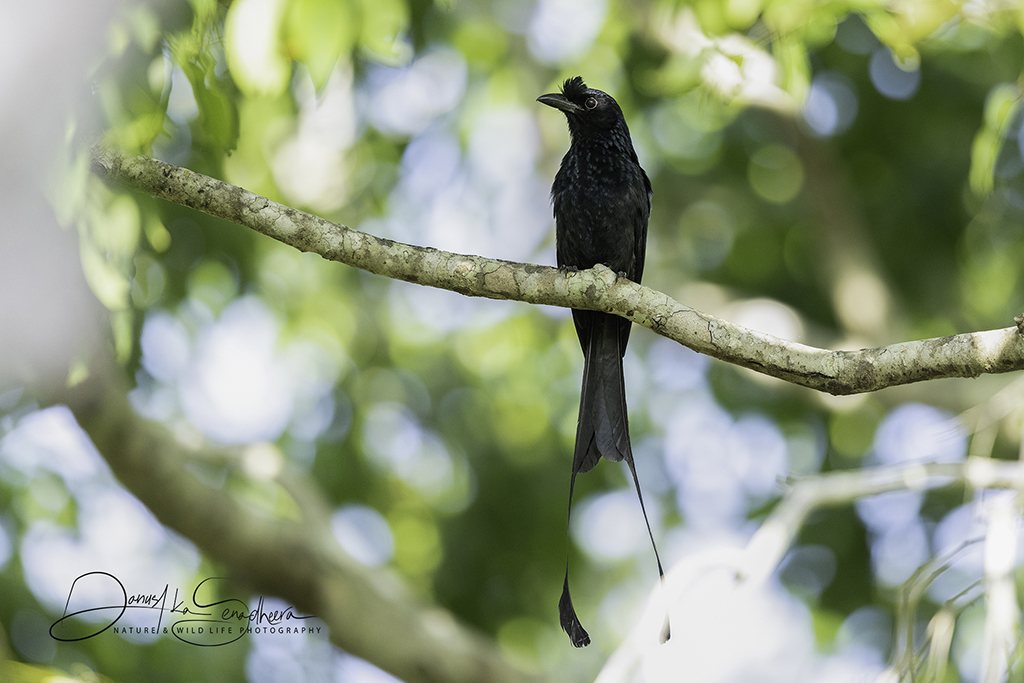
Due to its habitat, the Greater Racket-tailed Drongo is a difficult bird to photograph. During our last visit to Kumana National Park, we were fortunate to spot this beautiful individual. We were on the bund of a reservoir, and the bird was perched on a large Madam tree in the distance. This vantage point provided us with a slight advantage, allowing us to match the canopy height where the drongo was perched.